01 Overview
As Elastic's product surface expanded to include agentic workflows, conversational interfaces, and autonomous detection systems, the design team faced a compounding problem: every team was solving the same AI UX challenges independently with no shared language or reusable components.
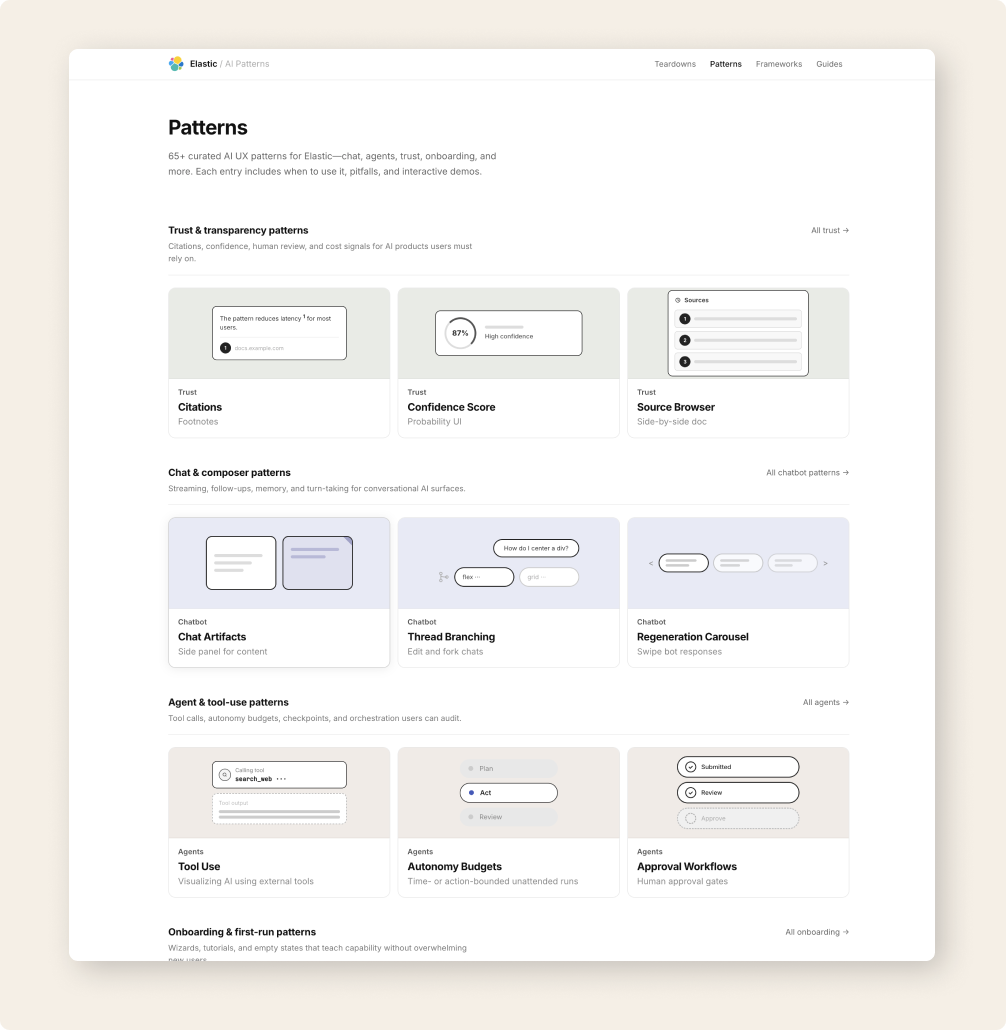
I led the design and curation of the Elastic AI Design System — a living library of 65+ patterns covering trust and transparency, chat and composer interfaces, agent and tool-use flows, and onboarding. Each entry includes a definition, when to use it, common pitfalls, real-world examples, and an interactive demo.
02 The Problem
Elastic's AI surface area expanded rapidly across security, search, and observability. Each product team designed their own approach to trust signals, reasoning transparency, and human-in-the-loop flows. The result was inconsistent experiences, duplicated effort, and no shared baseline for what good looked like in AI product design.
03 My Role
04 The System
How do you show users what an AI did, how confident it is, and where information came from? Patterns include Citations, Confidence Score, Source Browser, Human Review Gates, and Cost Signals.
Streaming responses, follow-up suggestions, thread management, and turn-taking for conversational AI. Patterns include Chat Artifacts, Thread Branching, Regeneration Carousel, and Composer Shortcuts.
Designed for agentic products where AI takes actions rather than surfaces information. Patterns include Tool Use, Autonomy Budgets, Approval Workflows, Activity Logs, and Undo Windows.
How do you teach users what an AI can do without overwhelming them? Patterns include Capability Showcases, Progressive Disclosure, Empty State guidance, and Confidence Calibration.
05 Pattern Anatomy
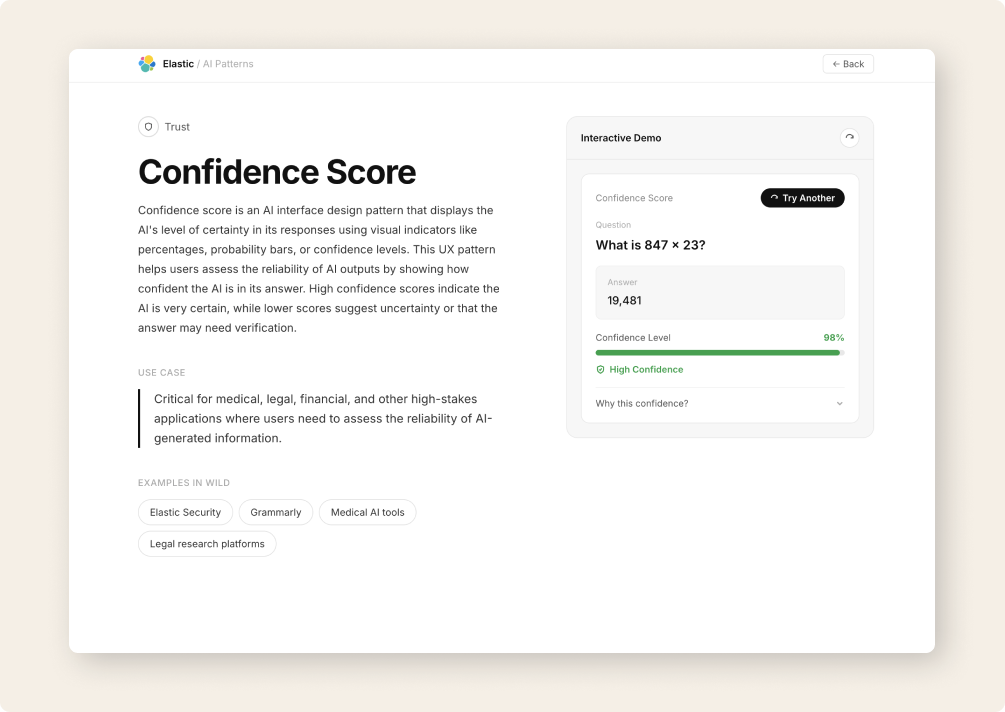
Each entry includes six elements so designers can find what they need without reading everything.
06 Impact
The system is used by product teams across Elastic Security, Search AI, and Observability. Patterns developed for AutoDEX were extracted into the library and adopted across other Elastic AI surfaces. Several patterns have since been contributed into EUI as official components.
The interactive demos were specifically requested by engineering teams as a behaviour reference, reducing the gap between design intent and implementation.